
AirCore Guidelines – Adsorber / 吸附器
1. TSA Principle / 变温吸附原理
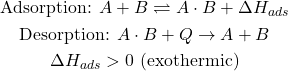
Temperature Swing Adsorption (TSA) is the standard method for removing H₂O and CO₂ from air in ASU pre-purification units. The process alternates between adsorption (at process conditions) and regeneration (at elevated temperature). Dual-tower operation ensures continuous air supply: one tower adsorbs while the other regenerates. 13X molecular sieve selectively adsorbs CO₂, while activated alumina preferentially adsorbs H₂O.
变温吸附(TSA)是空分预纯化单元中去除空气中 H₂O 和 CO₂ 的标准方法。该工艺在吸附(工艺条件)和再生(高温)之间交替进行。双塔操作确保连续供气:一塔吸附时另一塔再生。13X 分子筛选择性吸附 CO₂,活性氧化铝优先吸附 H₂O。
2. Adsorption Load Calculation / 吸附负荷计算
Water vapor load is calculated using Magnus formula for saturation pressure. At 35°C, P_sat ≈ 5.62 kPa. For saturated air (RH=100%), water mole fraction = P_sat/P_total. CO₂ load is based on ppmv concentration. Both loads are integrated over adsorption time to get total mass per cycle. Adsorbent mass can be auto-calculated from load and dynamic capacity (with safety factor), or manually specified in kg.
水蒸气负载使用 Magnus 公式计算饱和蒸气压。35°C 时 P_sat ≈ 5.62 kPa。饱和空气(RH=100%)的水摩尔分数 = P_sat/P_total。CO₂ 负载基于 ppmv 浓度。两种负载均在吸附时间内积分得到每周期总质量。吸附剂质量可根据负载和动态容量自动计算(含安全系数),也可手动输入(kg)。
![\begin{gathered} P_{sat} = 0.6108 \cdot \exp\left(\frac{17.27 \cdot T}{T + 237.3}\right) \text{ [kPa]} \\ y_{H_2O} = \frac{P_{sat}}{P_{total}} \\ \dot{m}_{H_2O} = \frac{Q_{Nm^3/h}}{22.414} \cdot y_{H_2O} \cdot M_{H_2O} \\ M_{H_2O,cycle} = \dot{m}_{H_2O} \cdot t_{ads} \\ m_{Al} = \frac{M_{H_2O}}{C_{Al}/100} \times (1 + SF) \end{gathered}](https://www.cryogeny.cn/wp-content/ql-cache/quicklatex.com-d953a06ba2c0aa24f97afdaee02c03b5_l3.png "Rendered by QuickLaTeX.com")
3. Vessel Geometry / 容器几何尺寸
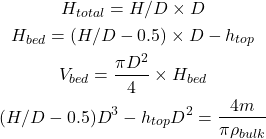
Vessel diameter is determined by H/D ratio and total adsorbent volume. Using Newton’s method to solve the cubic equation derived from bed height and cross-sectional area. Head height = D/4 (standard 2:1 elliptical head). Shell height = bed height + top space (distribution zone). Total height = shell height + 2 × head height. Bed contact time is typically 8 seconds.
容器直径由高径比和吸附剂总体积决定。使用 Newton 法求解由床高和截面积导出的三次方程。封头高度 = D/4(标准 2:1 椭圆封头)。筒体高度 = 床高 + 顶部空间(分布区)。总高 = 筒体高度 + 2 × 封头高度。床层接触时间通常为 8 秒。
4. Vessel Design / 容器设计
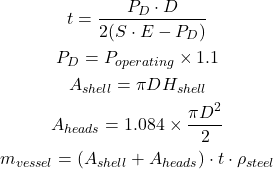
Wall thickness is calculated using pressure vessel formula: t = PD/(2SE-P). Design pressure = operating pressure × 1.1. Allowable stress for 16MnR steel at 150°C is 137 MPa. Vessel mass = surface area × wall thickness × steel density (7850 kg/m³). Head area includes 1.084 correction factor for standard 2:1 elliptical heads. Vessel mass can be manually specified or auto-calculated.
壁厚使用压力容器公式计算:t = PD/(2SE-P)。设计压力 = 操作压力 × 1.1。16MnR 钢在 150°C 时的许用应力为 137 MPa。容器质量 = 表面积 × 壁厚 × 钢密度(7850 kg/m³)。封头面积包含 1.084 修正系数(标准 2:1 椭圆封头)。容器质量可手动指定或自动计算。
5. Pressure Drop – Ergun / 压降 – Ergun方程
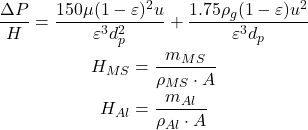
Pressure drop is calculated using Ergun equation for both MS and Al layers. The equation accounts for viscous (low Re) and inertial (high Re) contributions. MS layer: dp=2mm, ε=0.38. Al layer: dp=3mm, ε=0.40. Total ΔP = ΔP_MS + ΔP_Al. Each layer’s height is calculated from mass, bulk density, and cross-sectional area.
压降使用 Ergun 方程分别计算 MS 层和 Al 层。该方程考虑了粘性项(低 Re)和惯性项(高 Re)的贡献。MS 层:dp=2mm,ε=0.38。Al 层:dp=3mm,ε=0.40。总 ΔP = ΔP_MS + ΔP_Al。各层高度由质量、堆积密度和截面积计算。
6. Energy Balance Q1-Q5 / 能量平衡
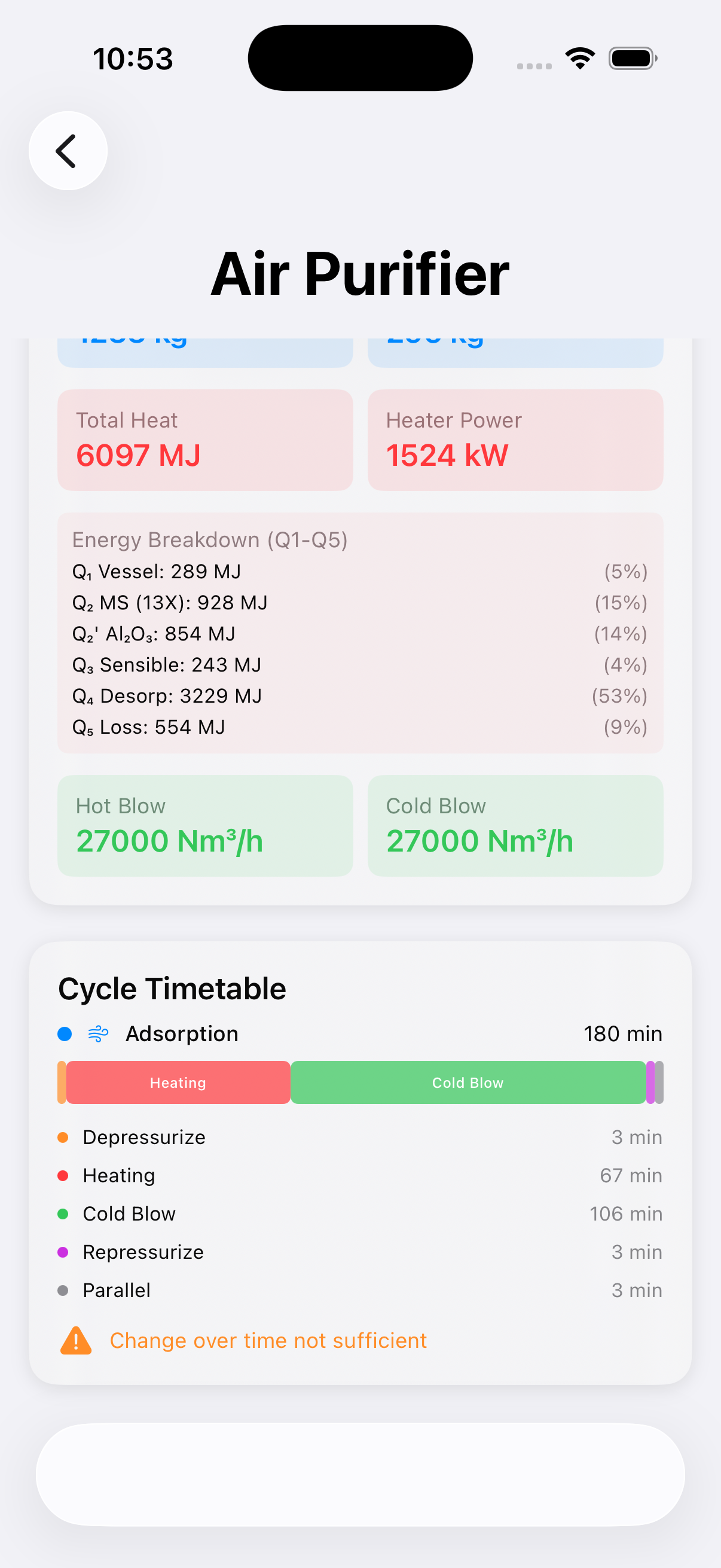
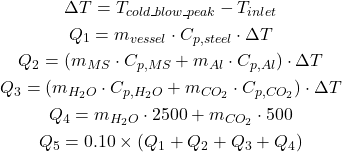
Regeneration energy uses cold blow peak temperature (default 80°C) as the maximum bed temperature rise. Q₁ = vessel steel sensible heat, Q₂ = adsorbent sensible heat (MS + Al₂O₃), Q₃ = H₂O and CO₂ sensible heat, Q₄ = desorption heat (H₂O: 2500 kJ/kg, CO₂: 500 kJ/kg), Q₅ = heat loss (10%). Total heat Q_total = Q₁+Q₂+Q₃+Q₄+Q₅.
再生能量以冷吹峰值温度(默认 80°C)作为床层最高温升。Q₁ = 容器钢壳显热,Q₂ = 吸附剂显热(MS + Al₂O₃),Q₃ = H₂O 和 CO₂ 显热,Q₄ = 脱附热(H₂O: 2500 kJ/kg,CO₂: 500 kJ/kg),Q₅ = 热损失(10%)。总热量 Q_total = Q₁+Q₂+Q₃+Q₄+Q₅。
7. Heater Power / 加热器功率
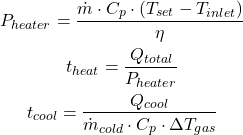
Heater power heats regen gas from inlet temperature to heater set temperature: P = ṁ·Cp·(T_set-T_inlet)/η. Heating time = Q_total / P. Cold blow time = Q_cool / (ṁ·Cp·ΔT_gas). Remaining time for depressurize, repressurize, and parallel steps is split equally. Warning shown if depressurize time < 10 min.
加热器功率将再生气体从入口温度加热到设定温度:P = ṁ·Cp·(T_set-T_inlet)/η。加热时间 = Q_total / P。冷吹时间 = Q_cool / (ṁ·Cp·ΔT_gas)。降压、升压和并联的剩余时间平均分配。当降压时间 < 10 min 时显示警告。
8. Cycle Timing / 循环时间
Dual-tower TSA cycle: Adsorption (fixed 180 min) + Regeneration (calculated). Regeneration steps: Depressurize → Heating → Cold Blow → Repressurize → Parallel. Heating and cooling times are calculated from energy balance. Depressurize, repressurize, and parallel times are split equally from remaining time. Total cycle = adsorption + regeneration = 360 min (6 hr).
双塔 TSA 循环:吸附(固定 180 min)+ 再生(计算)。再生步骤:降压 → 加热 → 冷吹 → 升压 → 并联。加热和冷吹时间由能量平衡计算。降压、升压和并联时间由剩余时间平均分配。总循环 = 吸附 + 再生 = 360 min(6 hr)。

Default Parameters / 默认参数
| Parameter / 参数 | Default Value / 默认值 | Unit / 单位 |
|---|---|---|
| Heater Set Temperature / 加热器设定温度 | 180 | °C |
| Regen Gas Temperature / 再生气体温度 | 40 | °C (inlet + 5 / 进气温度+5) |
| Cold Blow Peak Temperature / 冷吹峰值温度 | 80 | °C (regen gas + 40 / 再生气体+40) |
| Bed Contact Time / 床层接触时间 | 8 | s |
| Design Velocity / 空塔气速 | 0.25 | m/s |
| Safety Factor / 安全系数 | 0.4 | – |
| Heat Loss / 热损失 | 10 | % |
| Adsorption Time / 吸附时间 | 180 | min |
Generated from AirCore Adsorber Guidelines / 由 AirCore 吸附器指南生成